
Huber Heights Directory Collections
The core historical stop is the Dayton Metro Library Dayton Room, on the Main Library's second floor at 215 E. Third St. in Dayton. Its local-history collection spans more than 200 years of Dayton, Montgomery County, and Miami Valley material, including directories, maps, newspapers, census resources, microfilm scanners, and reference help. The room is generally open Monday through Thursday from noon to 4 p.m., with other times by appointment. Call 937-463-2665 or email history@daytonmetrolibrary.org before a visit, especially when a particular volume matters.
| Collection | Years | Where Held | Access |
|---|---|---|---|
| Dayton Room local-history collection | 200+ years of Miami Valley context | DML Main Library | Open stacks, reference help, appointment options, scanners and microfilm |
| Combination Atlas Map of Montgomery County | 1875 | Dayton Remembers / DML Map Collection | Digitized as montco1875; scan must be checked against OCR |
| Williams' Dayton City Directory | Serial begins 1856? | DML catalog and Dayton Room | In-library use; ask staff about individual volumes |
| Haines Dayton & Suburban Criss-cross | Local inclusion not confirmed online | DML catalog and Dayton Room | In-library, address-oriented volume |
| Polk and Dayton North Suburban serials | Polk 1995-; North Suburban 2000- | DML catalog and Dayton Room | Confirm the needed locality and issue with staff |
No public catalog record proves a consecutive Huber Heights run. The catalog establishes a route to the shelf, not that every issue names the city. Ask staff to check the desired Huber Heights, Wayne Township, Miami Villa, Dayton, and Miami Valley volumes.
Huber Heights Directory Catalogs
The Williams' Dayton City Directory catalog record identifies a changing serial published by Williams Publishing Co. It is an in-library resource, so a catalog entry does not replace a look at the dated volume. The library also catalogs the Haines Dayton City & Suburban Criss-cross Directory, an address-oriented form that can help when a street is already known. Record the year and title exactly, because directory titles and geographic coverage changed over time.
The Williams catalog image is a useful starting point for requesting the correct historical directory serial.
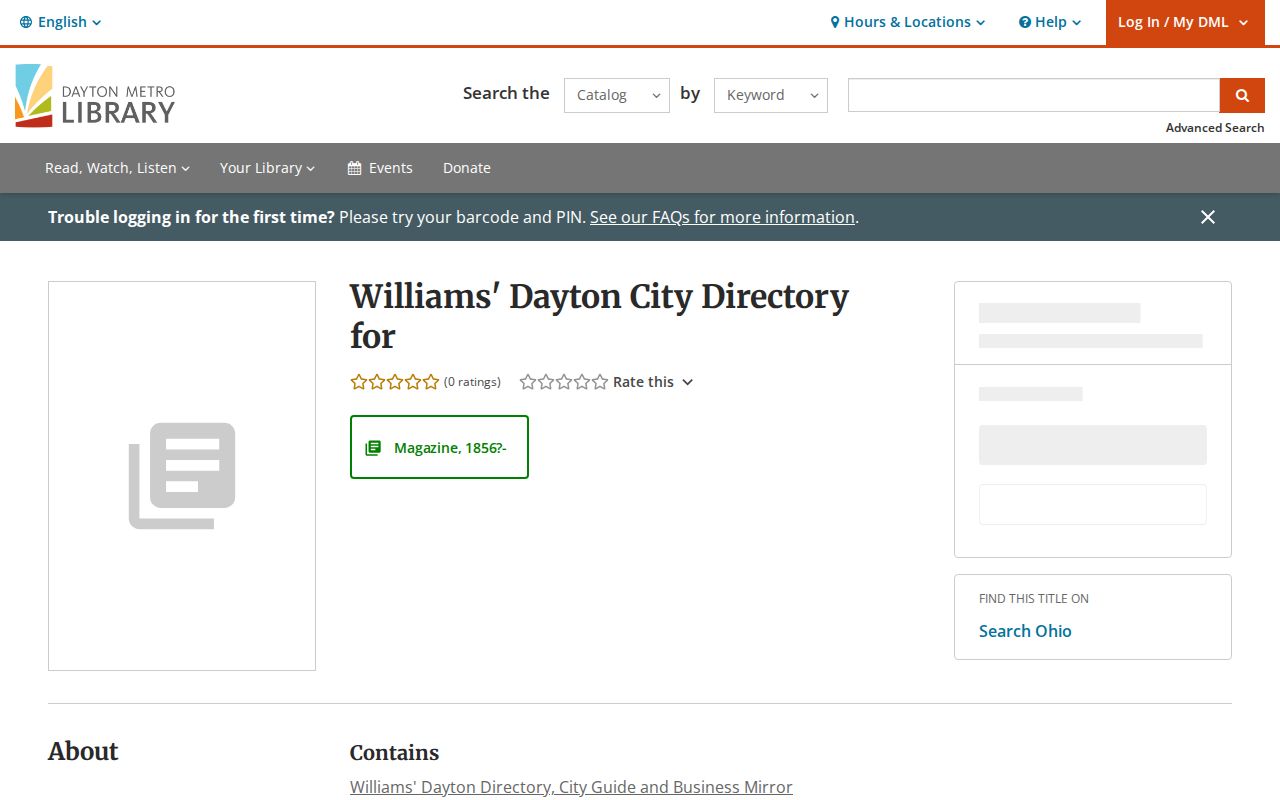
At the library, verify whether the particular issue includes the former township or a related Dayton-area listing before treating a missing name as meaningful.
The Haines catalog record identifies the reverse-directory path, but it does not prove an unbroken local sequence.
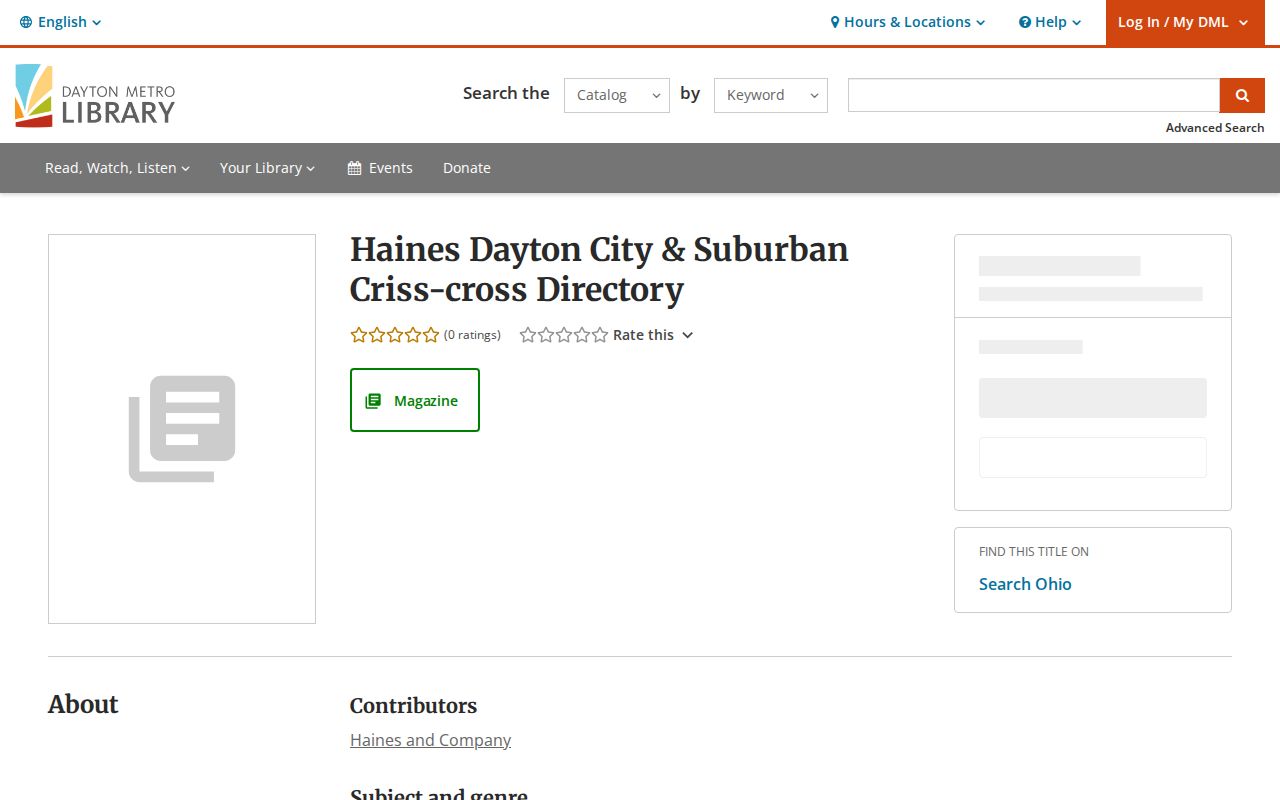
That distinction keeps a catalog clue from becoming an unsupported claim about a particular address or year.
Huber Heights Directory Shelves
The Dayton Room is more than a shelf of names. Its maps, local newspapers, government documents, photographs, and in-library genealogy tools make it a practical fallback when an online search ends early. Its staff and local-history experts can help distinguish a printed directory from a census, map, or obituary citation. The Genealogy Collection is in open stacks during library hours, while some licensed databases have in-library conditions. Bring the name variants, a date range, and a street or township clue rather than relying on the city name alone.
The Dayton Remembers digital collection represents the online source layer beside the Dayton Room's physical shelves.
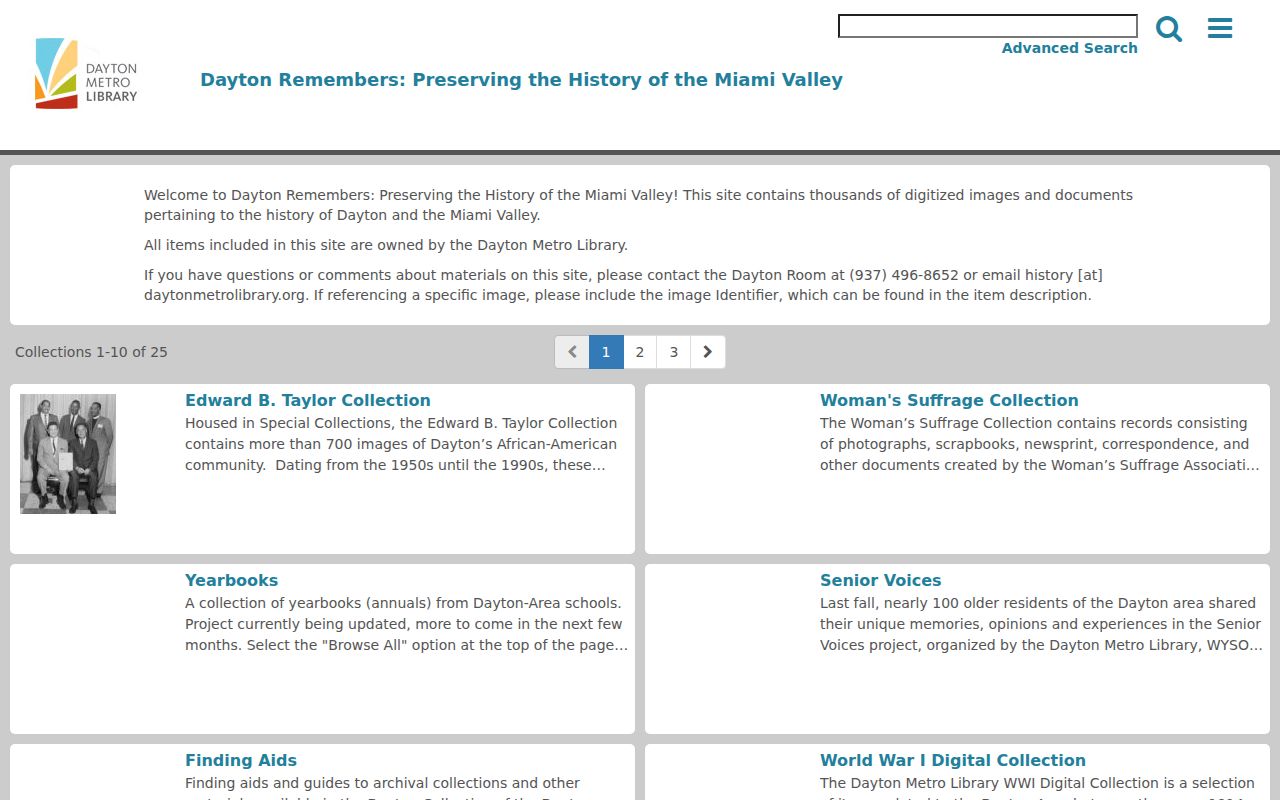
For a historical listing, the library can connect a printed entry to nearby newspapers, maps, or a census schedule without suggesting they all prove the same fact.
Note: Save the full title, publication year, page, and printed spelling before asking for a copy or a second source.
Huber Heights Directories Before 1981
Huber Heights was Wayne Township before incorporation in 1981. Voters adopted the City Charter in 1983, effective January 1, 1984. That change explains why an older directory, map, tax item, church record, or newspaper may not use the current city name. A negative search for Huber Heights before incorporation calls for a Wayne Township search, plus Miami Villa and broader Dayton or Miami Valley terms. It does not establish that no record exists.
The digitized 1875 Combination Atlas Map of Montgomery County is a verified early lead. Published by L. H. Everts/Hunter Press, it contains City Directory and Township Personals pages 166 through 172 and names Wayne Township in its contents. It is not an annual residential roll or proof of a modern address. Check the scanned page, not just its uncorrected OCR, then corroborate the entry with deeds, census, probate, or later listings.
The 1875 atlas image points to the directory and township-personals source within a Montgomery-side Wayne Township search.
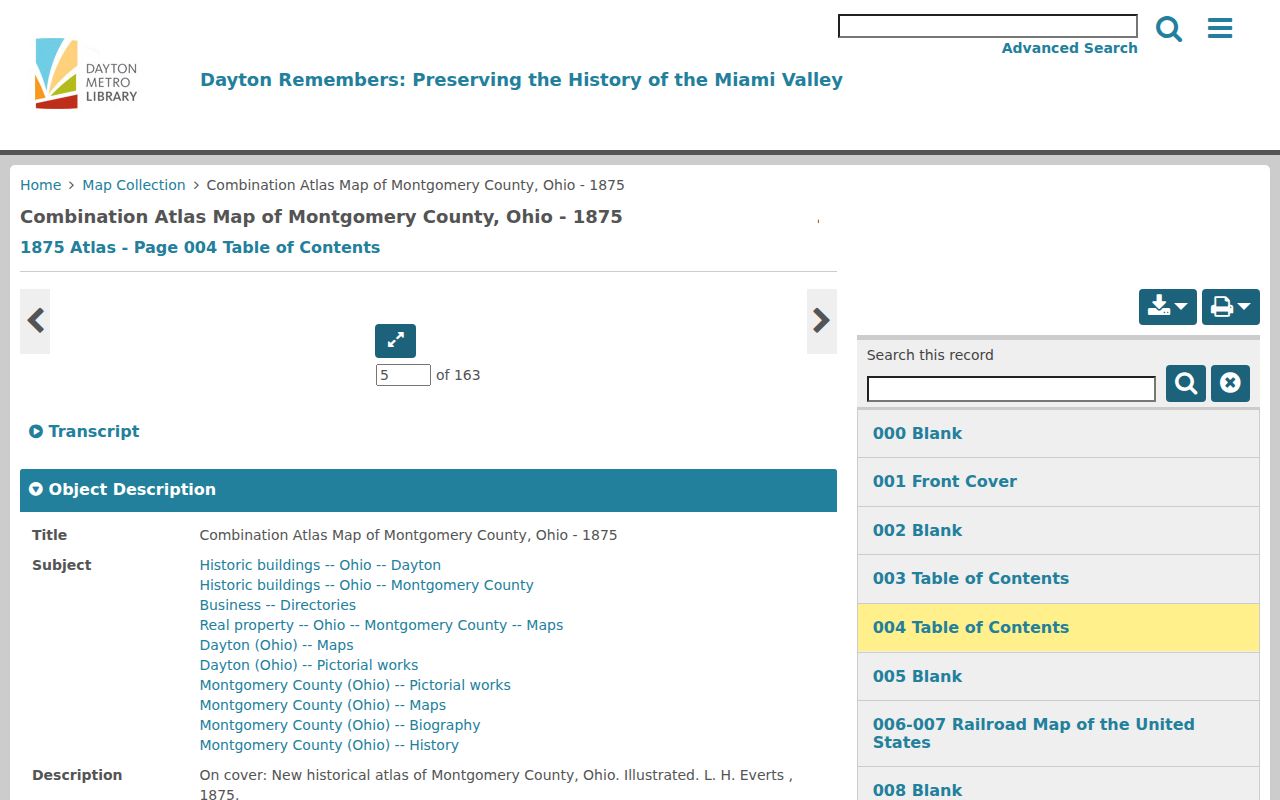
Its value is a precisely cited historical lead, not evidence of continuous residence or a standardized street address.
Huber Heights Directory Reverse Volumes
A reverse, or criss-cross, directory is arranged by address rather than by surname. It can move a known historical address toward a printed name, while the surname section works in the opposite direction. The Haines series is an address-oriented catalog path, but the online catalog does not confirm the exact Huber Heights issues. Ask to see the local abbreviation key in the actual volume before interpreting its marks.
- Criss-cross directory
- An address-order listing that may lead from a street number to a printed name or business entry.
- Householder index
- A name arrangement centered on the listed head of a household, not a complete roster of everyone at the address.
- Abbreviation key
- The volume's own explanation of abbreviations. Photograph or transcribe it before expanding shorthand.
Use the next annual volume only after checking the prior listing's street, spelling, and date. Modern address-keyed work belongs with the Huber Heights by-street directory, where county parcel sources control the current property trail.
Huber Heights Directory Obituary Clues
The Dayton Obituary and Genealogy Database, known as HOBITS, can extend a directory trail to a death-notice citation. Its listed runs are 1850-1880, 1897-1898, 1900, 1903-1918, 1920-1939, 1951-1957, 1965, and 1985 to the present, with more dates added. Search by keyword, first name, last name, publication, or date, then refine with the citation fields and sort control. The result is a citation rather than the obituary text.
The HOBITS search image shows the citation-focused entry point for Huber Heights directory research.
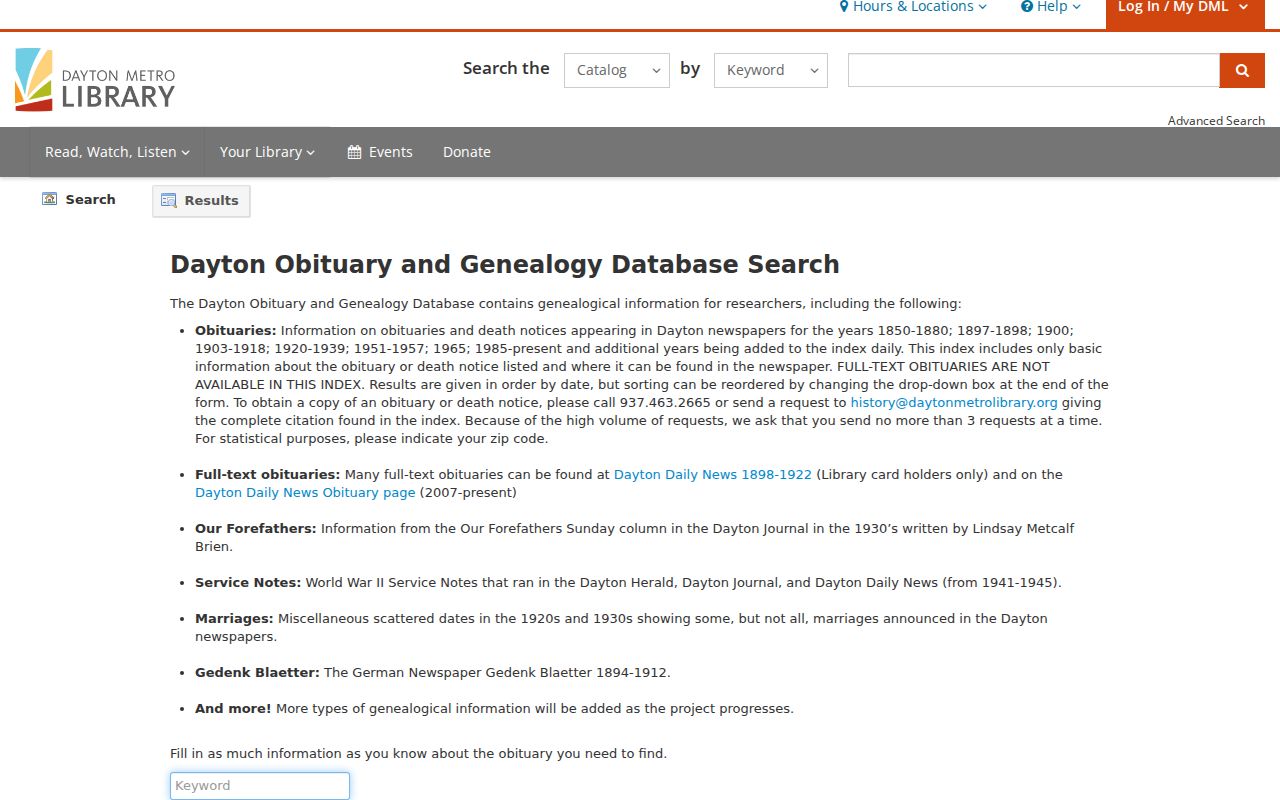
Give the full citation to the Dayton Room at 937-463-2665 or history@daytonmetrolibrary.org when requesting a copy, and send no more than three requests at once.
Reading a Huber Heights Directory
A printed entry often puts a name beside an occupation or other context, a residence, and a page location. It may contain spouse or widow notation, but punctuation and abbreviations differ by edition. The safe practice is to record the entry as printed, including page and spelling, rather than translating it into a modern household or address claim. A directory date is an editorial or publication date, not an exact move date.
| Name | Record the exact surname, initials, and spelling shown in the volume. |
|---|---|
| Context | Copy any occupation, spouse, widow, business, or locality notation without guessing its meaning. |
| Residence | Preserve the printed street or locality as a dated listing, not a modern-address match. |
| Page | Save the page or column so another researcher can check the original. |
A person in an atlas or directory may be a lead for a property, census, or probate search. It does not establish current residence, household composition, or a year-by-year presence.
Tracing Huber Heights Directories
Use a city directory sequence as a dated trail, not a one-step answer. Start with the clearest name or address, check the historic place name, and look at adjacent years where they exist. Pair the directory years with property transfers and the public federal census. Census schedules through 1950 are public under the 72-year access rule, while later enumerations are not. If a listing disappears, consider a move, death, omission, or changed name before choosing a conclusion.
- Search the surname and first initial under Huber Heights, Wayne Township, Miami Villa, and relevant Dayton or Miami Valley titles.
- Copy the entry, including its date, page, residence wording, and the volume's abbreviation key.
- Check the prior and next available directory volumes for spelling, locality, and address changes.
- Pair the dated listing with the appropriate public census, deed, or probate material.
- Use a HOBITS citation to request the underlying notice when a death trail is relevant.
For an apparently matching modern person, verify the link through the responsible custodian and the record's date. A historical listing alone is not enough.
Huber Heights Directory Contacts
The Wayne Township-Huber Heights Historical Society is another local-history contact, at 5950 Longford Road in Huber Heights. Visits are by appointment, and its published mission is to collect, preserve, research, and interpret the area's heritage. No online inventory of city directories, maps, fees, or other collections was published during the research. Contact the society before assuming a particular volume is available, and give the historic name, approximate date, and subject of the request.
The Historical Society image identifies the appointment-based local collection channel.
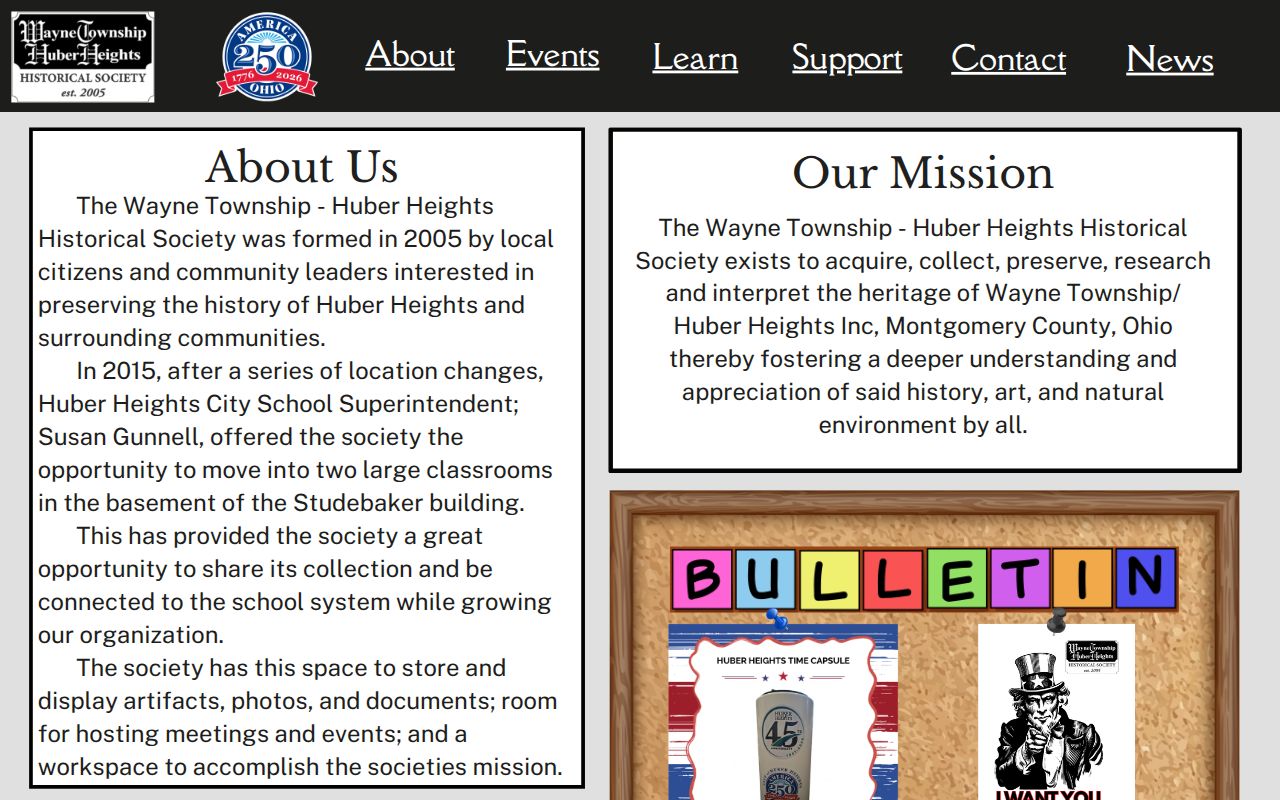
Its collections can provide orientation or private leads, while the library and county offices remain the places to confirm the relevant public record.
Huber Heights AgendaQuick is a companion source for dated Council agendas, packets, minutes, and audio or video. Its browse controls use meeting type, month, and year; full-text search uses a From month/year, To month/year, and text field. It can point to a dated civic participant or development matter, but it is not a directory collection or proof that someone lived at the address discussed.
Huber Heights Directory Preservation
Dayton Room holdings have a local preservation story. Dayton Metro Library notes that the 1913 Dayton flood devastated library collections, and librarian Electra Doren returned to rebuild them. That context helps explain why the Dayton Room is a key bridge between printed sources and later digital tools. It does not establish that every county record book was lost, and no authoritative Huber Heights courthouse-loss event was located.
The Dayton Remembers collection adds a digitized local-history layer to a Huber Heights city directory search. When an online record is not enough, retain the township name, date, title, and page, then ask the library, archives, or original county office for the next source.
Montgomery deeds begin in 1805, while the county guide places Auditor tax material from 1984 forward. The catalog, a scanned atlas, and a deed index serve different dates and purposes, so each citation should stay attached to the record it actually supports.